Generative AI tools are now a routine feature of marketing, advertising, and communications workflows. When deployed thoughtfully, these tools have a variety of benefits: reduced costs, accelerated production timelines, and expanded creative capacity. When used without adequate guardrails, AI tools can generate problems just as easily as content: intellectual property risk, reputational harm, and increased regulatory scrutiny.
As organizations integrate AI-generated content into public-facing materials, legal and compliance teams are increasingly asked to address a common set of questions: Who owns AI-generated outputs? What infringement risks arise from model training practices or output similarities? And how should companies structure internal review and approval processes to manage these risks at scale?
This article highlights several key intellectual property and related legal risks associated with generative AI and identifies practical steps companies can take to mitigate exposure when deploying AI-generated content in consumer-facing contexts.
Key IP Risks in AI-Generated Content
Copyrightability
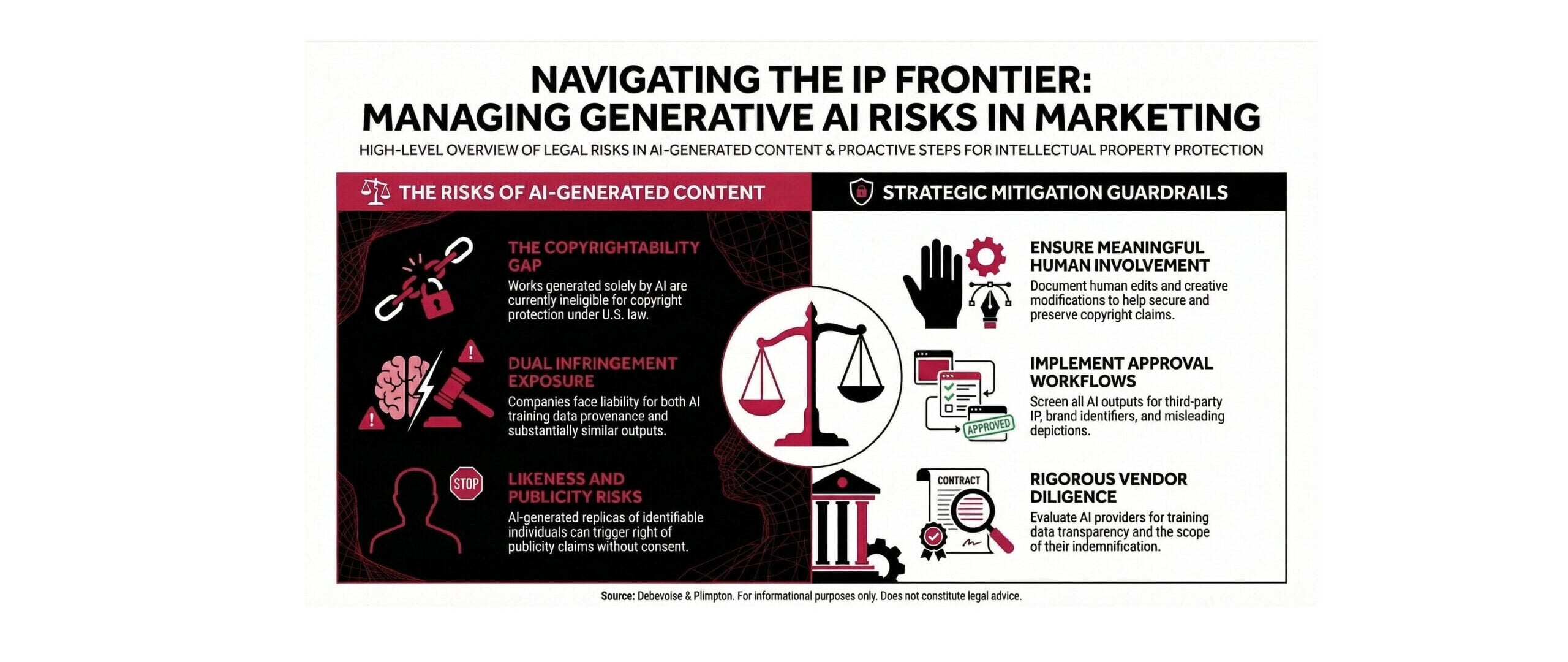
Under current U.S. law, works generated solely by AI are not eligible for copyright protection. Companies can claim copyright only in aspects of a work that reflect meaningful human authorship, such as substantive editing, selection, arrangement, or creative modification of AI-generated material.
For marketing and communications teams, this distinction has practical consequences. AI-generated content may be well suited for background, low-value, or short-lived assets where exclusivity is not critical. But where maintaining exclusive rights is commercially important, such as for flagship brand materials, national advertising campaigns, or proprietary visual identities, use of AI is riskier. Reliance on unmodified or lightly edited AI outputs in these contexts can undermine or even preclude efforts to secure and enforce ownership rights.
Where the decision is made to use AI, companies should carefully document the respective contributions of human authors and AI systems, including when, how, and to what extent AI-generated content is modified, curated, or incorporated into the final work. Ensuring documented, substantive human involvement in the creation process can help preserve copyright protection where it matters most. Note that to the extent that companies also wish to preserve privilege for materials created or revised using AI, there may be additional considerations to keep in mind.
Even where an AI-generated output is not itself copyrightable, companies may still be able to protect and enforce rights in human-authored elements incorporated into the final asset, such as original text, photographs, illustrations, layouts, or other creative components. In practice, this means that using AI to modify or adapt existing human-authored materials (rather than generating assets “from scratch”) can help preserve enforceable rights in the underlying work, and in some cases support claims based on the copying of protectable human-authored expression.
Where copyright protection is uncertain or unavailable, trademark and trade dress rights may offer an alternative means of protecting valuable brand identifiers. Trademark law does not impose a “human authorship” requirement in the same way copyright does; what matters is whether a logo, slogan, packaging, character, or other element functions as a source identifier in commerce. For certain AI-assisted brand assets, a coordinated copyright-and-trademark strategy can help preserve exclusivity and support enforcement.
Copyright Infringement
The use of generative AI also presents copyright infringement risk. A wave of lawsuits has been brought by copyright holders against AI developers, alleging unauthorized use of protected works in the development and operation of generative AI models. (We have summarized key developments from 2025 in this rapidly evolving area.)
These infringement claims generally rest on two related theories. First, rightsholders have alleged that AI models were trained on copyrighted works without authorization and that the ingestion and use of those works as training data itself constitutes infringement (so-called “training data claims”). Second, rightsholders assert that AI-generated outputs infringe where they reproduce or are substantially similar to existing protected works.
These allegations have important implications for companies beyond the original AI model developers. A company that deploys a product or service built on or incorporating an AI model—such as a customer-facing chatbot—may face exposure to training data claims depending on the provenance of the underlying model and the scope of its training. Companies incorporating third-party AI tools should therefore consider seeking clear information regarding the sources of training data and evaluating whether, and to what extent, their AI providers offer indemnification for training-related infringement claims.
Courts have recognized that companies can face copyright liability tied to a vendor’s or contractor’s infringing conduct where the company benefits from the infringement and has the right and ability to supervise or control it. In September 2025, for example, the Ninth Circuit reinstated a verdict holding Walt Disney Pictures vicariously liable based on its contractor’s infringement of visual effects software used in the production of Disney’s 2017 Beauty and the Beast film. This decision, while not an AI case, underscores a practical point for AI deployments: vendor diligence and contractual controls can materially affect risk allocation when a third-party technology provider’s practices are challenged.
In addition, if a court were to conclude that a particular AI model was developed through infringing use of copyrighted works, there is a potential risk that downstream users could face risks associated with continued use of assets generated by that model, even where the specific outputs at issue are not themselves infringing. While this theory remains untested, the possibility underscores the importance of diligence regarding model provenance and contractual protections when selecting AI providers.
Downstream users of AI tools also face risk of output-based claims. A company that publicly deploys AI-generated content that is substantially similar to a copyrighted work may face infringement allegations, even where the similarity is unintentional. This underscores the importance of AI prompt discipline and careful review of AI outputs, so that content is generated under defensible guardrails and assessed prior to public release.
Prompting an AI tool to generate specific copyrighted works, recognizable characters, or distinctive creative styles associated with particular artists or rights-holders can increase exposure. Screening AI-generated content for substantial similarity to existing works remains an important safeguard, particularly for materials intended for wide distribution. Having documented policies on both fronts, and training employees on AI use, can help substantially mitigate risk.
Trademark Infringement
Trademark infringement risk arises when AI-generated content incorporates brand names, logos, slogans, or distinctive design elements in a manner likely to cause consumer confusion or dilute the fame of a well-known trademark. An AI-generated image that includes a recognizable logo or trade dress even incidentally may create litigation risk, especially if the image is used in advertising or promotional contexts.
Because generative tools can introduce brand-like elements without user intent, companies should modify their review processes to incorporate checks for inadvertent trademark use in public-facing materials prior to publication.
False Advertising, Right of Publicity, and Consumer Deception
AI-generated content may implicate false advertising and consumer protection laws. Consumer-facing materials that depict products, features, endorsements, or scenarios that do not actually exist, or that could reasonably be mistaken for real offerings may be misleading to consumers. The risk is heightened where AI-generated images or videos create a strong impression of realism. Again, companies should consider incorporating checks for these pitfalls into content review procedures and training employees on appropriate uses of AI-generated content. Regulators are actively scrutinizing companies’ practices when using AI in advertising, increasing potential risk.
In some circumstances, disclosures or labeling of AI-generated content may be advisable to reduce the risk of consumer confusion, particularly where the line between fictional and real-world representations is not clear.
The use of AI-generated content also raises right of publicity (“RoP”) risks, particularly where outputs depict or evoke identifiable individuals. AI-generated images, videos, voice clones, or other likenesses that resemble real people, such as celebrities, executives, or influencers, can give rise to claims that a person’s name, image, voice, or persona has been used without consent for commercial purposes.
These risks have recently increased following developments like New York’s enactment of a landmark AI-focused right of publicity law that expands protections against unauthorized digital replicas and post-mortem uses. (We discussed these amendments and their implications for AI-generated content in more detail in our recent article on the New York legislation.) Companies deploying AI in public-facing contexts should develop safeguards to prevent the generation or use of realistic depictions of identifiable individuals without appropriate authorization, and should carefully review AI outputs for inadvertent likenesses before publication, particularly in advertising, marketing, or other commercial materials.
Practical Risk-Mitigation Measures
- Companies deploying AI-generated content in public-facing materials should consider implementing guardrails across the content lifecycle, including creation, review, vendor management, and post-deployment monitoring. Training and documentation are key: employees should know what is and not permissible, and have resources to consult when questions arise.
- Human Involvement. During content creation, organizations should ensure meaningful human involvement where copyright protection is important and maintain records of prompts, edits, and approvals. Avoiding over-reliance on unedited AI outputs can help mitigate both ownership and infringement risks.
- Approval Workflows. As part of IP and compliance review, companies may wish to adopt internal approval workflows for public-facing AI-generated materials. Reviews should screen for recognizable third-party IP, celebrity likenesses, misleading depictions of products or services, and common AI artifacts that may undermine credibility or signal automated generation.
- Vendor Agreements. Vendor terms and risk allocation also warrant close attention. AI provider agreements vary widely in the scope of indemnification offered for third-party IP claims, and many include exclusions where outputs have been modified, prompts violate usage policies, or content is used in certain high-risk contexts. Understanding these limitations is critical to assessing and mitigating residual exposure.
- Updated Policies. Internal IP and AI governance policies should be revisited regularly to reflect new case law, regulatory guidance, and enforcement priorities. When policies change, employees should be informed in clear and conspicuous ways, and trained on the new policy if changes are material.
Looking Ahead
Generative AI will continue to play a growing role in how companies communicate with consumers and other stakeholders. While the legal landscape is constantly evolving, organizations can reduce exposure today by adopting thoughtful governance structures, clear review processes, and disciplined use of AI tools.
Proactive planning—rather than reactive remediation—will be key as courts, regulators, and rights-holders continue to scrutinize the use of AI-generated content in commercial contexts.
*****
To subscribe to the Data Blog, please click here.
The cover art for this blog was generated by Nano Banana Pro.