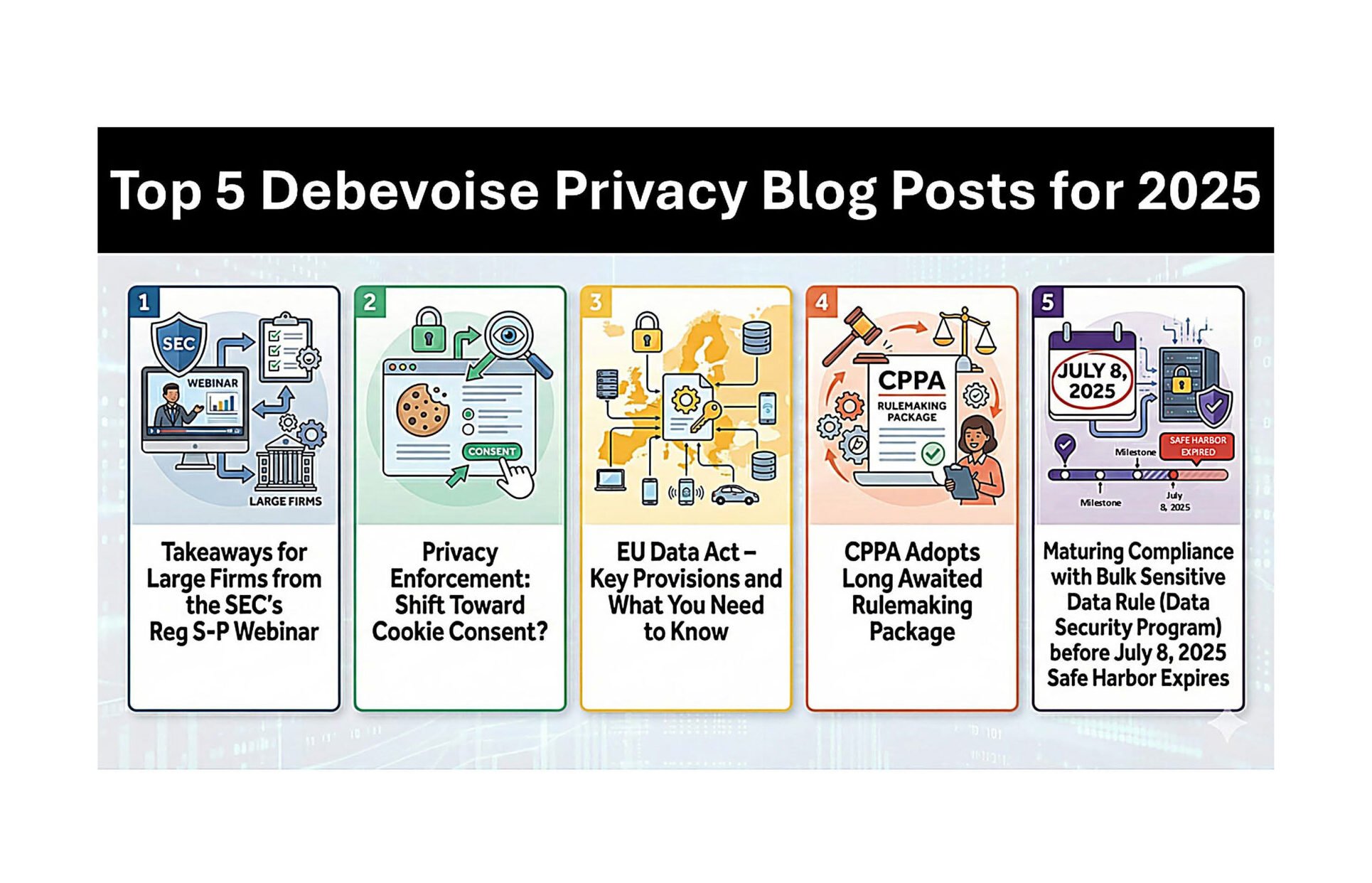
As we approach the end of the year, here are the top 5 privacy posts on the Debevoise Data Blog in 2025.

  1. Takeaways for Large Firms from the SEC’s Reg S-P Webinar (September 28, 2025)

On September 25, 2025, the SEC held a webinar on Regulation S-P, which governs how covered institutions protect customer information. In this post, we highlight key takeaways from the webinar, including the expanded scope of customer information under the 2024 amendments (which took effect earlier this month), the amended Regulation’s applicability to private funds and their advisers and the new incident-response notification requirements.

  1. Privacy Enforcement: Shift Toward Cookie Consent? (April 24, 2025)

On March 12, 2025, the California Privacy Protection Agency (the “CPPA”) announced a decision and stipulated final order stemming from its investigation of the American Honda Motor Company’s data privacy practices. State regulators have been increasingly scrutinizing cookie banners and cookie management tools, and the CPPA’s decision exemplifies privacy regulator concerns over cookie non-compliance with state consumer privacy law. Some states now require clear cookie opt-out mechanisms, and in California businesses must also provide a “symmetry of choice” in the cookie banner. In this post, we unpack how Honda fell short of this requirement—resulting in a $632,500 fine—and how businesses can refine their cookie-consent practices to strengthen compliance with consumer privacy law.

  1. EU Data Act – Key Provisions and What You Need to Know (October 9, 2025)

On September 12, 2025, the main provisions of the EU Data Act took effect, establishing rules on who can access and use data generated by connected devices and related services. Aimed at creating a common European data space, the Act is expected to have a significant impact on multinational businesses by requiring them to share data with customers and competitors.

  1. CPPA Adopts Long Awaited Rulemaking Package (July 25, 2025)

On July 24, 2025, the California Privacy Protection Agency approved a major rulemaking package that adds new requirements for cybersecurity audits and the use of automated decision-making tools. Businesses processing large quantities of personal information will face independent cybersecurity audit obligations. Businesses using automated tools to make significant decisions will be required to provide disclosures and opt-out rights absent an exemption. In this post, we explain what these changes mean and how businesses can prepare for the upcoming compliance timelines.

  1. Maturing Compliance with Bulk Sensitive Data Rule (Data Security Program) before July 8, 2025 Safe Harbor Expires (May 28, 2025)

On July 8, 2025, the civil enforcement safe harbor for the DOJ’s sweeping Bulk Sensitive Data Rule expired. The Rule limits transfers of large volumes of sensitive data to certain foreign entities deemed threats to national security. Organizations holding significant amounts of sensitive or government-related data should assess their cross-border data flows, and review the DOJ’s guide for good-faith compliance to prepare as enforcement begins.

Summarized by Melyssa Eigen, Ella Han, and Linh Tang. We used ChatGPT to help generate first drafts of the summaries. The cover art for this blog was generated by Gemini 3 Nano Banana Pro.

To subscribe to the Debevoise Data Blog, please click here.

Author

Charu A. Chandrasekhar is a litigation partner based in the New York office and a member of the firm’s White Collar & Regulatory Defense and Data Strategy & Security Groups. Her practice focuses on securities enforcement and government investigations defense and artificial intelligence and cybersecurity regulatory counseling and defense. Charu can be reached at cchandra@debevoise.com.

Author

Luke Dembosky is a Debevoise litigation partner based in the firm’s Washington, D.C. office. He is Co-Chair of the firm’s Data Strategy & Security practice and a member of the White Collar & Regulatory Defense Group. His practice focuses on cybersecurity incident preparation and response, internal investigations, civil litigation and regulatory defense, as well as national security issues. He can be reached at ldembosky@debevoise.com.

Author

Avi Gesser is Co-Chair of the Debevoise Data Strategy & Security Group. His practice focuses on advising major companies on a wide range of cybersecurity, privacy and artificial intelligence matters. He can be reached at agesser@debevoise.com.

Author

Erez is a litigation partner and a member of the Debevoise Data Strategy & Security Group. His practice focuses on advising major businesses on a wide range of complex, high-impact cyber-incident response matters and on data-related regulatory requirements. Erez can be reached at eliebermann@debevoise.com

Author

Robert Maddox is a partner in Debevoise & Plimpton LLP’s Data Strategy & Security practice, based in London. In 2021 he was named to Global Data Review’s “40 Under 40” and is described as “a rising star” in cyber law by The Legal 500 US (2022). His practice focuses on cybersecurity incident preparation and response, internal investigations and regulatory defence. Mr. Maddox also advises on data strategy and compliance in the context of emerging technologies, including AI, and operational resilience matters. He can be reached at rmaddox@debevoise.com.

Author

Julie M. Riewe is a litigation partner and a member of Debevoise's White Collar & Regulatory Defense Group. Her practice focuses on securities-related enforcement and compliance issues and internal investigations, and she has significant experience with matters involving private equity funds, hedge funds, mutual funds, business development companies, separately managed accounts and other asset managers. She can be reached at jriewe@debevoise.com.

Author

Kristin Snyder is a litigation partner and member of the firm’s White Collar & Regulatory Defense Group. Her practice focuses on securities-related regulatory and enforcement matters, particularly for private investment firms and other asset managers.

Author

Rick Sofield is a partner and Co-Head of the firm’s National Security Group based in Washington, D.C. His practice focuses on matters with national security implications. He can be reached at rcsofield@debevoise.com

Author

Sheena Paul is a counsel in the Investment Management Group’s U.S. regulatory practice, based in the firm’s Washington, D.C. office. Ms. Paul focuses her practice on providing regulatory advice to investment managers, with a particular focus on private equity clients. She works closely with the firm’s other practices on regulatory advice related to domestic and cross-border corporate and capital markets transactions, and enforcement matters. She can be reached at spaul@debevoise.com

Author

Johanna Skrzypczyk (pronounced “Scrip-zik”) is a counsel in the Data Strategy and Security practice of Debevoise & Plimpton LLP. Her practice focuses on advising AI matters and privacy-oriented work, particularly related to the California Consumer Privacy Act. She can be reached at jnskrzypczyk@debevoise.com.

Author

H Jacqueline Brehmer is a Debevoise litigation associate and a member of the Data Strategy & Security Practice Group. She can be reached at hjbrehmer@debevoise.com.

Author

Martha Hirst is an associate in Debevoise's Litigation Department based in the London office. She is a member of the firm’s White Collar & Regulatory Defense Group, and the Data Strategy & Security practice. She can be reached at mhirst@debevoise.com.

Author

Suchita Mandavilli Brundage is a former associate in the Debevoise Data Strategy & Security Group.

Author

Melyssa Eigen is an associate in the Litigation Department. She can be reached at meigen@debevoise.com.

Author

Ned Terrace is an associate in the Litigation Department. He can be reached at jkterrac@debevoise.com.

Author

Michelle Shen is a former associate in the Litigation Department.

Author

Diane C. Bernabei is an associate in the Litigation Department. She can be reached at dcbernabei@debevoise.com.

Author

Mengyi Xu is a former associate in the Litigation Department.