
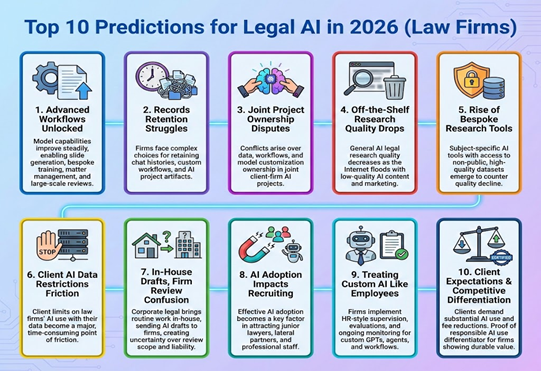
We are experimenting with a shorter format for more frequent blog posts. Let us know what you think. Here are our top 10 predictions for AI use by law firms in 2026:
Matter Management
- Model capabilities will keep improving steadily, unlocking new powerful workflows, including slide generation, bespoke training, matter management, and large-scale document and contract review. Firms that can quickly turn these new capabilities into enhanced services for clients will gain market share.
- Law firms will struggle with complex data retention choices for chat histories, custom workflows, and AI project artifacts. For joint client-firm AI projects, disputes will arise as to who owns the data and the workflows, as well as any model customization, especially in circumstances when clients want to switch firms.
- Off-the-shelf AI-powered legal research will decrease in quality as the Internet increasingly fills with low-quality AI-generated content and with legal marketing materials that are disguised to look like legal thought leadership. This will give rise to bespoke subject-specific AI research tools with access to non-public high-quality legal datasets.
- Client restrictions on their law firms’ use of AI with client data will become a major, time-consuming point of friction between law firms and their clients.
- Corporate legal departments will accelerate bringing routine legal work in-house and sending their AI-generated drafts to law firms to review. This will create confusion as to what is the appropriate amount of review by a law firm of legal work generated by clients using AI, and when the reviewing law firm is responsible for the accuracy, completeness, and fitness-for-purpose of the final work product.
Talent Management
- Firms’ AI capabilities and fluency will become an important factor in recruiting junior lawyers, lateral partners, and professional staff.
- Firms will start treating custom GPTs, AI agents, and customized AI workflows like employees who must be supervised, and implement HR-style evaluations, supervision, and ongoing monitoring.
Client Development
- A small group of law firms will start showing significant, durable value from their use of AI.
- Clients will increasingly expect substantial AI use and will demand corresponding reductions in time spent and fees for routine legal tasks, leading to more fixed fee and subscription-based billing arrangements.
- Proof of responsible AI use by law firms, including policies, training, governance, and ongoing monitoring will become a competitive differentiator for clients when choosing among law firms for major assignments.
To subscribe to the Debevoise Data Blog, please click here.
The Debevoise STAAR (Suite of Tools for Assessing AI Risk) is a monthly subscription service that provides Debevoise clients with an online suite of tools to help them with their AI adoption. Please contact us at STAARinfo@debevoise.com for more information.
The cover art for this blog was generated by Gemini 3 (Nano Banana Pro).