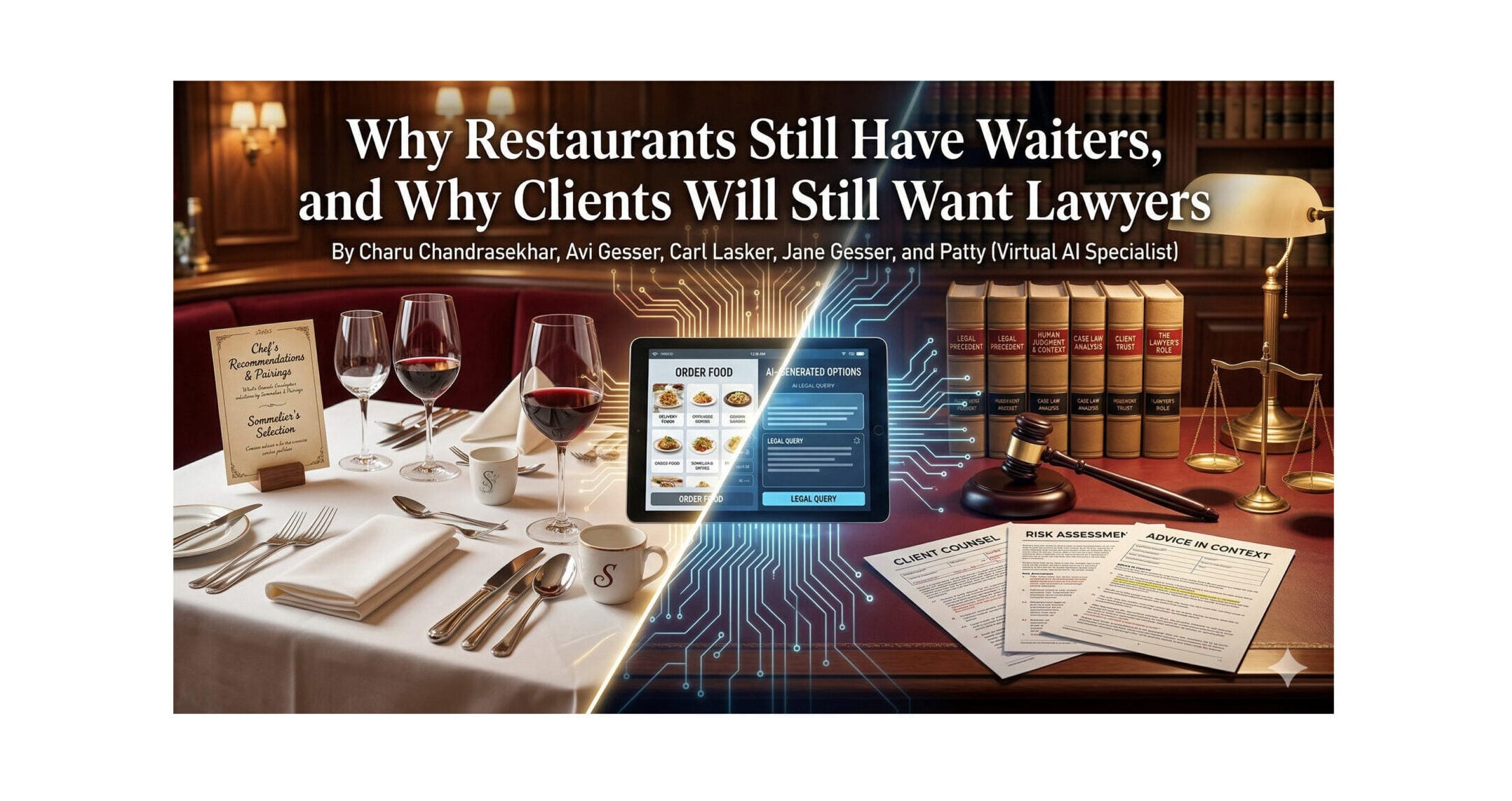
In a recent post, we argued that AI adoption could actually create more jobs for lawyers, pointing to radiology as a profession where rapid advances in AI have increased demand for human specialists. The restaurant experience offers another useful lens through which to view the future of legal work in an era of widespread AI adoption.
Today, in most restaurants, customers could theoretically order without ever speaking to a waiter. Indeed, at many airports, fast-casual chains, and some traditional restaurants, customers do order from a tablet, a kiosk, or their phones. The menu is there. The prices are there. The dish photos are there, and the system can route the order directly to the kitchen. And yet, the vast majority of restaurants still offer waiter service because ordering food is not just a matter of transmitting information. People often need a human touch.
A good waiter does much more than read the menu aloud. She knows the food. She knows what people actually like. She knows which dish is richer than it sounds, which special is worth ordering, and which substitution the kitchen will permit even though it is not printed on the menu. She may also offer guidance on things beyond the menu: where to go nearby for dessert, whether there is a good place to hear live music after dinner, or what might make the evening better overall. If she has seen you before, she may know your preferences already. If she has not, she can ask a few questions and figure them out quickly. Do you want something light? Are you sharing? Do you have time for a full meal, or do you need to catch a train? Are you in the mood to experiment, or do you want the safe choice? Do you care more about price, speed, presentation, or comfort? A good waiter doesn’t just provide access to options; she helps you navigate them.
That’s also what good lawyers do. Clients don’t go to outside counsel because legal information is hard to find. It’s not. They do so because they want access to someone who understands the terrain, knows them, and can help them make sound decisions that balance multiple factors. They want someone who can explain not just what the rule says, but how it works in practice. They benefit when a lawyer spots adjacent needs the client may not even realize exist, or identifies risks, flags opportunities, and looks around corners to raise issues the client hasn’t considered. They want someone who can identify which facts matter, which risks are real, which changes are possible, which paths are customary, what is too much risk, what is not enough risk, and which “obvious” choices may lead to regret.
A menu is useful, but it is not the meal, and AI-generated legal output is similarly not necessarily good legal service. A waiter also provides validation. Sometimes the customer already knows what he wants, but still wants some confirmation. “That’s a very popular choice.” “Those go well together.” “That’s my favorite thing on the menu.” That kind of reassurance reduces uncertainty, makes action easier, and improves the overall experience.
Lawyers often play the same role. A client may have a strong instinct about what to do, but still wants a trusted professional to pressure-test the decision, confirm that it is sensible, indicate (without naming names) whether other clients have followed a similar path, and flag anything the client may have missed. That’s more than information delivery. It is reading the room, risk transfer, and judgment applied in context.
A good waiter can instantly assess whether the meal is a rushed lunch between meetings; a first date; a family dinner with a picky child; a celebration where no one wants to think too hard. The same menu can call for very different kinds of service depending on the setting, the people, and the unstated priorities.
For lawyers, the right answer for one client may be the wrong answer for another, even if the legal issue looks identical to ChatGPT. Context matters. Tone matters. Institutional preferences matter. Timing matters. Relationships matter. The best lawyers are not just technically accurate. They are situationally aware in a way that AI is not; acting like a sommelier, trying to find the exact right wine for the particular meal ordered by the particular collection of guests, on that particular night.
That said, AI will dramatically impact legal services, and there is going to be a lot of self-service ordering of legal content because in some settings, it is clearly the better model. If the transaction is standardized, low-risk, and speed matters most, a tablet may outperform a lawyer. And as AI improves, there will be more matters where clients are happy to get the equivalent of quick, competent self-service.
But as access to legal information becomes cheaper and easier, the relative value of human guidance will surely rise. The lawyers who add the most value will be the ones who do more than recite the menu. They will know the client, ask the right questions, identify the available options and adjustments, explain the tradeoffs, and help the client make the optimal choice with confidence. AI will reduce the value of being a human menu, but it will increase the value of being an excellent waiter.
To subscribe to the Data Blog, please click here.
The Debevoise STAAR (Suite of Tools for Assessing AI Risk) is a monthly subscription service that provides Debevoise clients with an online suite of tools to help them fast-track their AI adoption. Please contact us at STAARinfo@debevoise.com for more information.
The cover art for this blog post was generated by ChatGPT 5.2.